
Reviewed · BUENOS AIRES TOURS
From Colonialism to Eclecticism, Buenos Aires arquitectonica
Buenos Aires reveals its character through its buildings. On this three-hour walk, you move from the colonial Cabildo and Casa Rosada to the Brutalist Banco Hipotecario, the old Post and Telegraph Palace, grand theaters, and the Obelisk. It is less about checking off famous sights and more about learning how to read the city’s facades.
I like the small limit of four participants, which gives you room to ask questions and steer the talk toward your interests. I also like that Juan Ignacio and Loli add mate, Argentine snacks, and cultural stories rather than treating architecture as a dry list of dates. The main consideration is that this is an outdoor city walk, with no lunch and no entrance to Teatro Colón included.
Key points at a glance
- Compare many styles in one walk: See colonial, Neoclassical, Brutalist, modern, and theater architecture across central Buenos Aires.
- Look beyond the standard circuit: Banco Hipotecario and the Julio Argentino Roca School add less familiar buildings to the better-known Cabildo, Obelisk, and Teatro Colón.
- Travel with Juan Ignacio and Loli: Juan focuses on architects and periods, while Loli brings in stories tied to Argentina and South America.
- Taste mate properly: You receive a mate tasting and learn why the drink matters in Argentine culture.
- Keep the group very small: With a maximum of four people, you can ask detailed questions and request more focus on styles or local culture.
- Plan for a three-hour walk: Comfortable shoes, sun protection, and clothing suited to the weather will make the route easier.
Why this Buenos Aires architecture walk is different
Many city walks in Buenos Aires stay with the headline sights. This one uses those sights as a framework, then pulls your attention toward buildings you might otherwise pass without a glance. That makes the experience useful even if you have already seen Plaza de Mayo or photographed the Obelisk.
The route also crosses several parts of central Buenos Aires without requiring transport between stops. You begin at the city’s political center, follow Reconquista Street, reach the cultural corridor around Corrientes Avenue, and finish near Teatro Colón. Along the way, you see how different periods and ideas were placed side by side.
Juan Ignacio and Loli give the walk a two-part character. Juan is described as having a strong memory for architects, their lifespans, and the periods in which they worked. Loli adds stories connected with Argentine and South American culture. That division should suit you if you want both design facts and a sense of how buildings fit into local life.
The tour is offered in English or Spanish. Since the group is limited to four participants, you have a better chance to ask about a particular facade, architectural period, or cultural custom than you would on a large group walk.
Other Buenos Aires days worth putting on the same trip:
- Buenos Aires Hop-On Hop-Off Bus, Free Walking Tours & Discounts
★ 4.5 · 2,218 reviews - Buenos Aires: Piazzolla Tango Show with Optional Dinner
★ 4.4 · 2,122 reviews - Buenos Aires: City Highlights Guided Tour with Transfer
★ 4.7 · 1,946 reviews
Plaza de Mayo and the city’s colonial core
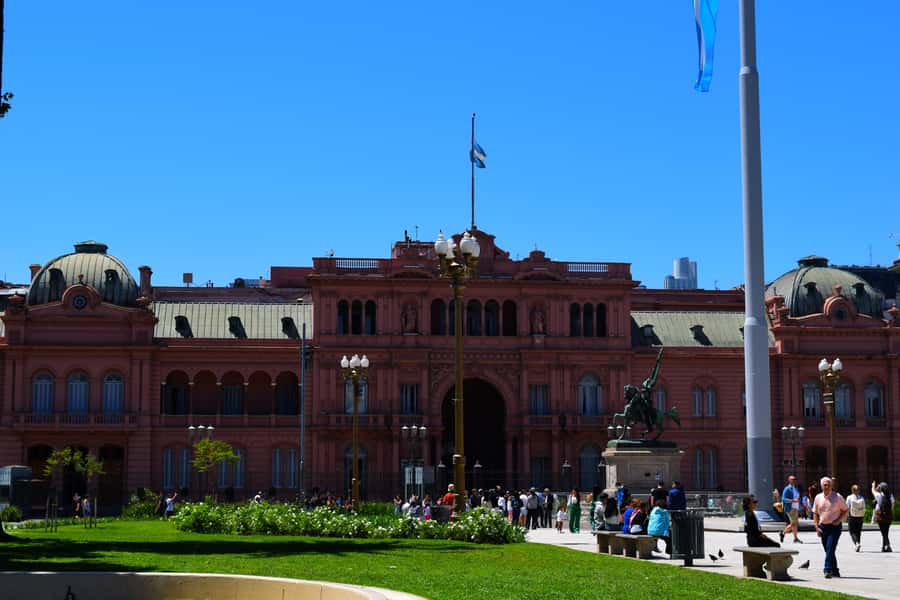
The meeting point is at Bolívar 65, at the intersection of Bolívar and Avenida de Mayo, in Plaza de Mayo. This is a sensible place to begin because the square brings together several of the country’s most important civic and religious buildings.
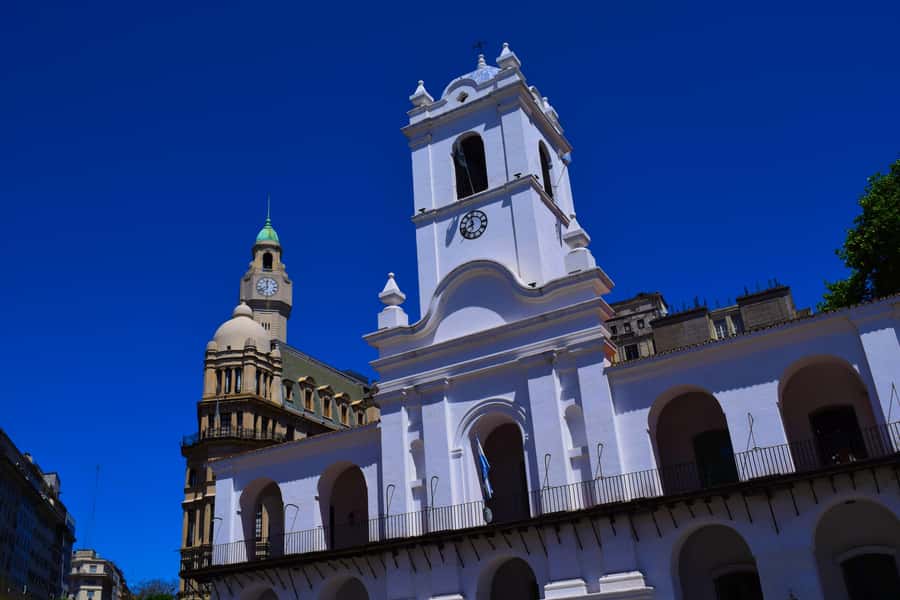
You look at the Cabildo, the Metropolitan Cathedral, Casa Rosada, and Banco Nación. The Cabildo gives the opening section a colonial starting point, while Casa Rosada represents the seat of national government. The Metropolitan Cathedral adds a religious counterpoint, and Banco Nación helps show how public and financial institutions occupy the same central district.
The value here is not simply the chance to take photographs. Your guide helps you compare the buildings and notice how their purposes shaped their appearance. If you usually admire a facade only for its color or size, this first section gives you a method for asking better questions: Who used it? What period does it reflect? What was the architect trying to communicate?
Plaza de Mayo is also tied closely to Argentina’s political and social life. The tour uses that setting to connect architecture with the country’s public story, rather than presenting each building as an isolated object.
Reconquista Street and the Banco Hipotecario facade
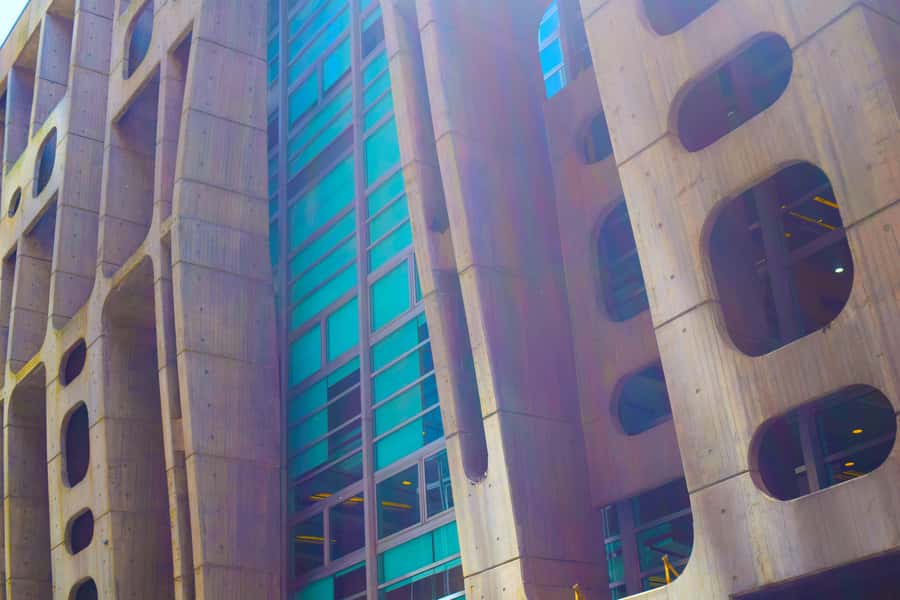
From the square, the walk heads north along Reconquista Street. The route then pauses at the headquarters of Banco Hipotecario, where the Brutalist facade provides one of the sharpest changes in style on the tour.
Brutalism is known for its forceful use of concrete and strong geometric forms. Here, the point is not that the building is conventionally pretty. It is that the facade makes you consider how a later architectural language can sit among older city blocks and still claim attention.
This is one of the tour’s most useful choices. The Cabildo and Casa Rosada are easy to find in guidebooks. A building like Banco Hipotecario may be easier to miss, yet it gives you a clearer view of how Buenos Aires developed beyond its colonial and grand European-influenced image.
If you enjoy architecture, this is a good place to ask Juan Ignacio about the architect and period. If you are more interested in city life, ask Loli how this kind of building fits into the changing identity of central Buenos Aires. The small group makes that sort of detour in conversation possible.
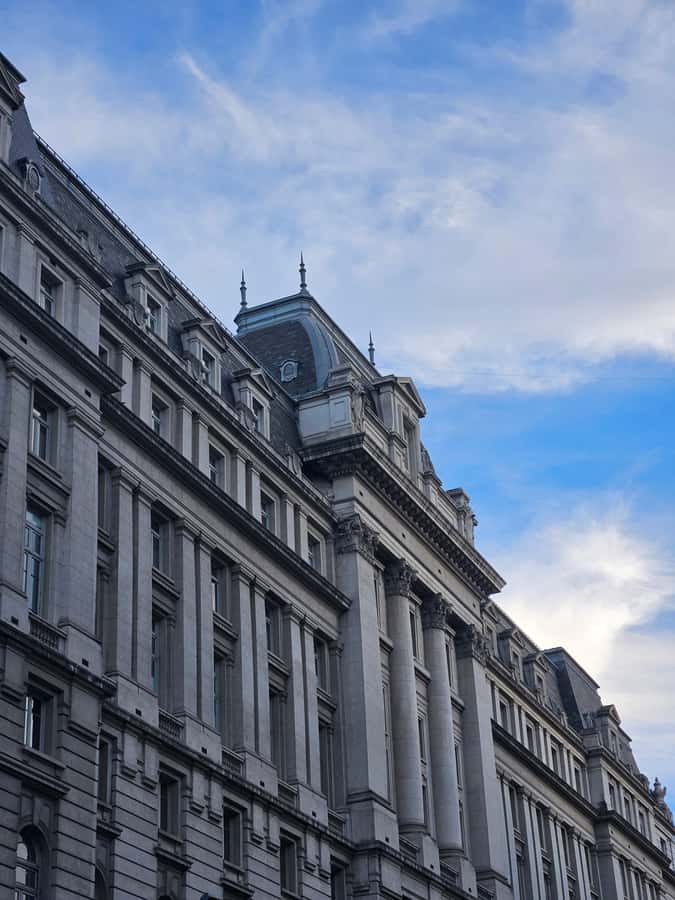
The former Post and Telegraph Palace at CCK
The next major stop is the CCK, formerly the Palacio de Correos y Telégrafos, or Post and Telegraph Palace. The visit here focuses on the facade and the building’s past.
The name matters. A post and telegraph palace was built for communication, government administration, and national reach. The building therefore reflects more than a decorative choice. It speaks to an era when messages, letters, and telegraph lines were central to how a country connected its people and institutions.
You stop to study the outside rather than entering for an extended interior visit. That keeps the tour moving, but it also means you should not book this walk expecting a full CCK museum visit. The emphasis is on the building’s exterior, its role, and the story attached to it.
This section fits the tour’s central idea: Buenos Aires is a city where different architectural periods share a few blocks. The former Post and Telegraph Palace adds another layer to the route, following the colonial and Brutalist examples with a building tied to public communication.
Completely different, still leaving from Buenos Aires:
- Buenos Aires: Hop-On Hop-Off City Bus Tour
★ 4.2 · 1,855 reviews - Buenos Aires Hop-On Hop-Off Bus and Exclusive Benefits
★ 4.4 · 1,714 reviews - Buenos Aires: La Boca Guided Walking Tour in English
★ 4.8 · 1,587 reviews - Buenos Aires: La Recoleta Cemetery Guided Tour in English
★ 4.8 · 1,359 reviews
Corrientes Avenue, Gran Rex, and the Opera
The walk then goes up Corrientes Avenue, a major center of Buenos Aires nightlife, culture, and shows. The avenue gives the tour a change of mood. Earlier stops focus more on government, religion, banking, and communication. Here, the subject turns to performance and popular city life.
You pass the Gran Rex and the Opera, two major theaters on the avenue. Their heyday belongs to an earlier period, but both continue to serve as places for performances and public gatherings. The guide explains their architectural features while also placing them within the cultural life of Buenos Aires.
I like this part because theaters are not just buildings to look at from the pavement. Their design often reflects how a city wanted to present entertainment, luxury, and shared public experience. You can expect the conversation to connect the visual details with the role these venues played, and still play, on Corrientes Avenue.
The drawback is simple: the tour passes these theaters rather than offering a ticketed performance. If you want an evening show, you will need to arrange that separately. The walk gives you context, not admission.
The Obelisk and a view along 9 de Julio
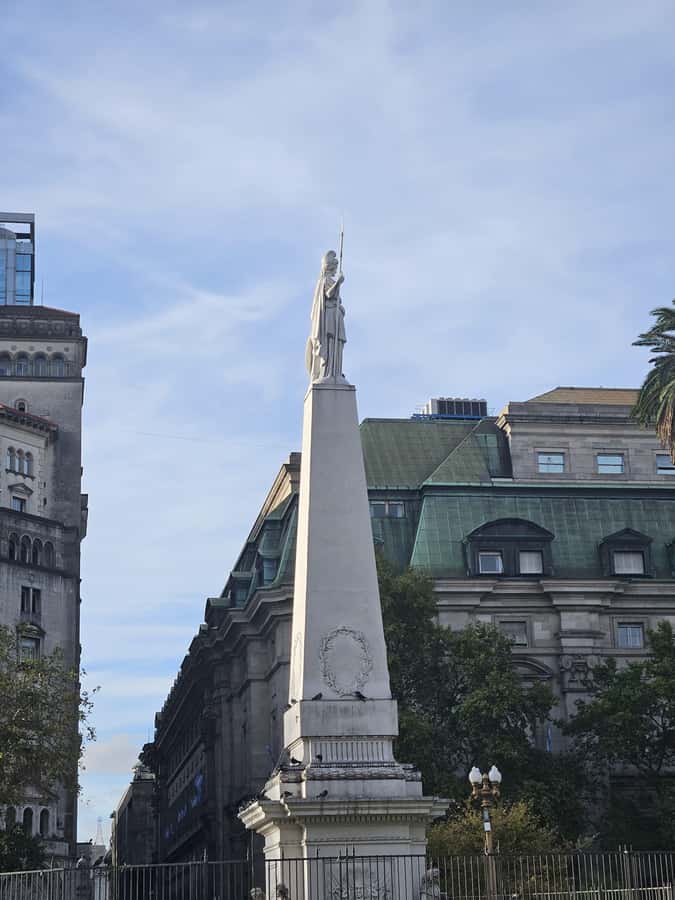
The first major part of the route ends at the Obelisk and Plaza de la República. This is one of Buenos Aires’ best-known landmarks, but the tour treats it as more than a quick photo stop.
You learn about the Obelisk’s history and its importance to the political and social life of the country. Its position also makes sense as a marker between the city’s historic core and the cultural route along Corrientes Avenue.
A short pause at the Obelisk staircase provides a view toward the meeting point of Avenida 9 de Julio and Corrientes. This is a useful stop for photographs and for seeing the scale of one of the city’s busiest intersections. The view helps you understand how grand avenues and traffic corridors shape Buenos Aires as much as individual buildings do.
Bring sunglasses, a hat, sunscreen, and comfortable clothes. The route includes open streets and public squares, and the tour information specifically recommends protection from the sun. Comfortable shoes matter more than stylish footwear here.
Plaza Lavalle and two contrasting civic buildings
The final section takes you to Plaza Lavalle. Here, the Courts Palace faces the Julio Argentino Roca School, giving you another chance to compare buildings with different functions.
A court building carries a formal civic role, while a school serves daily public life and education. Seeing them together lets the guide discuss how architecture communicates authority, learning, and institutional identity. This stop also keeps the tour from becoming a parade of only famous landmarks.
Plaza Lavalle is a fitting lead-in to Teatro Colón. The route has moved through political, religious, financial, communications, entertainment, and educational buildings. By this point, you should have a clearer sense of how central Buenos Aires combines many architectural languages within a compact area.
The tour ends at Teatro Colón, with an option to remain and arrange a guided interior visit. Admission to the theater is not included, so treat that as a separate activity. The booking information also describes the activity as ending back at the meeting point, while the route details identify Teatro Colón as the finish. Confirm the exact end arrangement when you reserve.
Mate, Argentine snacks, and the human side of the walk
Near the end, you have a mate tasting and learn about its place in Argentine culture. Mate is not presented as a decorative extra. It gives the architecture walk a social element and helps explain a daily tradition that you may notice throughout Argentina.
Water and a traditional Argentine snack are included as well. One snack described by the guide team is a typical cookie, which can be a useful introduction to local flavors without turning the walk into a food tour.
I see this as one of the strongest parts for visitors who want more than buildings. Architecture can feel distant when it is taught only through dates and styles. Sharing mate and discussing its meaning brings the conversation back to people, habits, and hospitality.
The tasting is also practical. You learn something you can recognize and ask about during the rest of your stay. Do not expect a full meal, though. Lunch is not included, so plan to eat before or after the three-hour walk.
What the $25 price buys you
At $25 per person, the tour is priced as a focused small-group experience rather than a large sightseeing circuit. The maximum group size is four, which is important to the value. You are paying not only for the route, but for the chance to ask questions and adjust the discussion to your interests.
The price includes an English- or Spanish-speaking guide, water, a traditional Argentine snack, and mate tasting. It does not include lunch or entry to Teatro Colón. If you want to tour the theater’s interior, budget for that separately.
The value is strongest for you if architecture is a major reason for visiting Buenos Aires, or if you want a guide to explain details you would not catch alone. It is less useful if you prefer a fast list of landmarks or want extensive interior access to every building.
You can reserve now and pay later, and cancellation is free up to 24 hours in advance for a full refund. That flexibility matters if your plans in Buenos Aires are still shifting.
Who should book this walk
I would choose this experience if you enjoy looking closely at city buildings, asking questions, and learning why a place looks the way it does. It is also a good fit if you want a mix of architecture and local culture, since mate and Argentine snacks are part of the plan.
First-time visitors can use it to get their bearings around central Buenos Aires. Repeat visitors may get even more from it because the route points out buildings that are easy to overlook on a standard visit.
The walk may not suit you if you have trouble with three hours of outdoor walking, want a restaurant-based food tour, or mainly care about going inside monuments. The route includes photo stops and exterior sightseeing, and the only interior visit mentioned is an optional guided visit to Teatro Colón after the tour.
Should you book From Colonialism to Eclecticism?
Book it if you want to see Buenos Aires through architecture, public life, and local custom, not just through a checklist of famous sights. The combination of Juan Ignacio’s architectural detail, Loli’s cultural stories, a group of no more than four, and a mate tasting gives the walk a personal shape.
The best reason to go is the range. In three hours, you move from the Cabildo and Cathedral to Banco Hipotecario, the former Post and Telegraph Palace, Corrientes theaters, the Obelisk, Plaza Lavalle, and Teatro Colón. You also learn how to notice buildings that may not appear on the usual sightseeing route.
Skip it if you need a fully indoor activity, a meal, or included admission to Teatro Colón. Otherwise, $25 is a fair price for a compact, question-friendly introduction to central Buenos Aires, especially if you come prepared for sun and comfortable walking.
FAQ
Where does the tour start?
It starts in Plaza de Mayo at Bolívar 65, at the intersection of Bolívar and Avenida de Mayo.
Where does the tour finish?
The route details identify Teatro Colón as the finish. The meeting point information also says the activity ends back at the meeting point, so confirm the exact end arrangement when booking.
How long does the walking tour last?
The tour lasts three hours. Starting times depend on availability.
What languages are available?
The tour is offered in English and Spanish, with a live guide.
How many people are in the group?
The group is limited to four participants.
Is Teatro Colón admission included?
No. Entrance to Teatro Colón is not included. You have the option to stay at the end and take a guided visit inside the theater.
Is food included?
Water and a traditional Argentine snack are included, along with a mate tasting. Lunch is not included.
Can I cancel the booking?
Yes. You can cancel up to 24 hours in advance for a full refund. You can also reserve now and pay later.
Recently added in Buenos Aires
- Buenos Aires: Private City Tour by Car with Hotel or Pickup★ 5.0 · 3 reviews
- Guided tour Boca Juniors Museum & Stadium + Caminito★ 3.3 · 3 reviews
- Buenos Aires: Montserrat, San Telmo, La Boca, and Puerto …★ 5.0 · 3 reviews
- Unique Tigre and Delta Private Day Cruise Navegation★ 5.0 · 3 reviews
- Buenos Aires: MALBA Museo de Arte Latinoamericano Tour★ 4.1 · 3 reviews
- Tango Show at: MichelAngelo★ 4.5 · 3 reviews
- Buenos Aires: Mate Workshop y Otras Yerbas★ 5.0 · 3 reviews
- Enjoy a Rural Experience in a Vineyard near Buenos Aires★ 4.7 · 3 reviews
Buenos Aires Tours, compared.

Buenos Aires: Piazzolla Tango Show with Optional Dinner
Read our review →
Buenos Aires: City Highlights Guided Tour with Transfer
Read our review →
Buenos Aires: La Boca Guided Walking Tour in English
Read our review →
Buenos Aires: La Recoleta Cemetery Guided Tour in English
Read our review →
Buenos Aires: Tango Show at Tango Porteño & Optional Dinner
Read our review →
Buenos Aires: 9-Course Argentine Meat Tasting at Fogón Asado
Read our review →
