Reviewed · BUENOS AIRES TOURS
Teatro Colon Guided Tour Admission Ticket
Teatro Colón is the kind of building that makes you slow down before the tour even begins. Inside, you’ll move through the Main Foyer, Gallery of Busts, Golden Hall, and auditorium of one of Buenos Aires’ great cultural landmarks. The theater opened in 1908 with Aïda, and its stage has welcomed Maria Callas, Plácido Domingo, Luciano Pavarotti, and famous ballet dancers.
I like the way this tour connects the decoration to the theater’s practical side, especially its celebrated acoustics. I also like the chance to step into a box and look across the auditorium, a small detail that gives you a better sense of how the theater works than a hallway-only visit.
The main caution is value. At $46 per person for roughly 50 minutes, this is not a cheap stop, and the working theater may have the auditorium dark or partly closed during rehearsals, technical checks, performances, or refurbishments.
Key points to know before you book
- The 1908 theater replaced an earlier Teatro Colón: The first venue operated from 1857 to 1888 before closing for construction of the present building.
- The route covers the showpiece interiors: Expect the Main Foyer, Gallery of Busts, Golden Hall, and auditorium or round floor, usually in a tour lasting about 50 minutes.
- A box-seat view may be the highlight: Several tours include a chance to sit in an exclusive box and look over the theater.
- English tours can fill early: Multiple start times are offered, but English-language places may be harder to secure close to the date.
- The theater remains a working venue: A rehearsal or lighting check can change what you see, including leaving the auditorium dim or dark.
- Your actual entrance ticket matters: Teatro Colón does not accept the regular Viator or TripAdvisor voucher, so follow the ticket delivery instructions carefully and print the attached ticket as requested.
Why Teatro Colón deserves an hour of your Buenos Aires time
Buenos Aires has no shortage of grand buildings, but Teatro Colón gives you more than a pretty interior. It shows how strongly the city looked toward European opera, ballet, architecture, and music at the turn of the 20th century.
The present theater opened on May 25, 1908, with a performance of Aïda. Its story began much earlier, in 1857, when the original Teatro Colón opened in a different building. That first venue closed in 1888, and construction of the replacement took years before the current house finally opened.
The result is a building shaped by three architects and several European artistic influences. Your guide explains how those influences appear in the details, rather than leaving you to admire a ceiling without knowing why it matters. You’ll hear about the theater’s design, its acoustics, and its place in Argentine cultural life.
You do not need to know anything about opera before arriving. The tour is built around the building itself, so you can enjoy it as an architectural visit, a music stop, or a lesson in Buenos Aires history. If you already attend opera and ballet, the theater’s stage traditions and famous performers add another layer.
The names connected with Teatro Colón are impressive. Maria Callas, Plácido Domingo, and Luciano Pavarotti have performed here, along with major dancers including Vaslav Nijinski and Mijail Baryshnikov. You are not simply touring an old hall. You are walking through a venue that still hosts opera and ballet today.
more tickets and entries in Buenos Aires
- Buenos Aires: Tickets to Boca Juniors Museum & Stadium
★ 4.5 · 581 reviews - Teatro Astor Piazzolla Skip-the-Line Ticket
★ 4.5 · 367 reviews - Skip the Line: Tango Porteño Only Show Ticket
★ 4.0 · 194 reviews
Starting at Cerrito 628
The meeting point is Teatro Colón at Cerrito 628 in central Buenos Aires. The attraction is near public transportation, so you can reach it without arranging a hotel transfer. Pickup and drop-off are not included, and the tour ends back at the theater.
Allow yourself extra time to find the entrance and read your ticket instructions before the start. One of the practical weak spots is that the tour does not always work like a private meeting with a representative waiting outside. You may need to exchange your ticket and join the standard guided group inside the theater.
The supplied meeting information points you to Teatro Colón itself, but some visitors have found the exact starting point confusing. I would arrive early, show the printed ticket to theater staff, and ask where the tour group is forming rather than assuming someone will come looking for you.
Multiple entrance times are available throughout the day. That makes it easier to fit the visit around a walking tour, lunch, or another central Buenos Aires sight. Still, do not treat the time as endlessly flexible. This is a timed admission, and the ticket is non-refundable.
The Main Foyer and first impressions
The tour begins with the public spaces that announce Teatro Colón’s ambition. The Main Foyer is designed for arrival, meeting, and ceremony, not just for moving people from the street to their seats.
Look up and around as you walk. The point of the guided visit is not only to see ornate surfaces, but to understand how the building was meant to make opera feel important before the curtain even rose. Your guide points out architectural details and explains how the theater developed over time.
This is where a good guide makes a real difference. Octavio has been praised for mixing facts with stories, while Kiara has been described as entertaining as well as well-informed. Adrian has also led an English-language visit, explaining the building’s history and the artistic influences behind its design. You are not guaranteed any one of these guides, but the best tours clearly depend on a guide who can make the details easy to follow.
The group size can reach 30 people. That is manageable in a large foyer, but it is not an intimate conversation. If the guide is not using a microphone, you may have trouble hearing from the rear, especially when the group gathers in a busy or echoing room. Stay close to the guide without blocking other people, and ask for clarification if you miss a point.
The Gallery of Busts and the theater’s cultural roll call
The Gallery of Busts gives the visit a quieter, more museum-like pause. Sculpted figures and references to major composers help connect the building to the wider European and Argentine music tradition.
This section rewards a slower look. You may hear about famous composers and the way the theater presents its artistic heritage. The Gallery of Busts is not as instantly dramatic as the auditorium, but it gives the tour a sense of purpose. Teatro Colón is not only a place with expensive decoration. It is a house built around music, performance, and the people who shaped those traditions.
The guide’s explanation is useful here because you might otherwise see a sequence of statues without knowing what you are looking at. If you enjoy architecture, sculpture, or classical music, this is one of the more informative parts of the route. If your main goal is a sweeping auditorium photograph, it may feel slower.
more guided days in Buenos Aires
- Buenos Aires: City Highlights Guided Tour with Transfer
★ 4.7 · 1,946 reviews - Buenos Aires: La Boca Guided Walking Tour in English
★ 4.8 · 1,587 reviews - Buenos Aires: La Recoleta Cemetery Guided Tour in English
★ 4.8 · 1,359 reviews - Palermo: Graffiti and Street Art Guided Tour in English
★ 4.8 · 684 reviews
The Golden Hall and the grand public rooms
The Golden Hall is the tour’s richest visual stop. Its decorative style suits the theater’s old-world image, with the sort of formal detail you expect in a major opera house.
Give yourself time to notice the room’s scale and finish. The Golden Hall is one of the places where the ticket begins to make more sense for visitors who care about architecture. You are paying for access to a building that is still used as a working theater, not just for a quick glimpse through a lobby.
That said, the tour is not a backstage tour. The route focuses on public halls, the Gallery of Busts, the Golden Hall, and the auditorium. Do not book it expecting costume rooms, workshops, technical areas, or an extended look behind the curtain. Those omissions matter if you are comparing this with a more specialized theater tour.
The guide also helps explain the relationship between style and function. The decorative spaces create ceremony, while the auditorium has to serve performers and audiences. That balance between beauty and practical design is one of the most interesting themes of the visit.
The auditorium, boxes, and the acoustics question
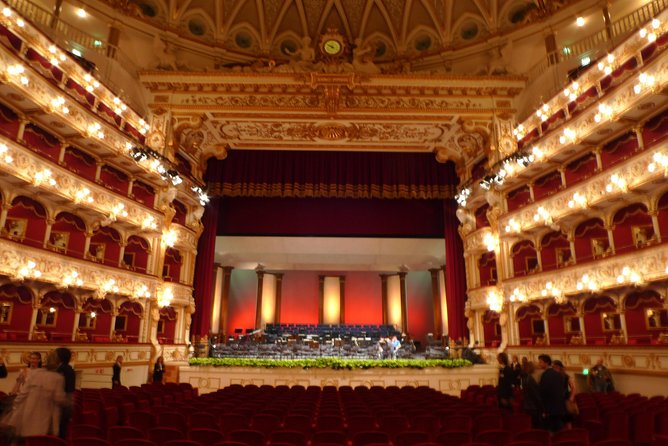
The auditorium is the emotional center of the tour. From the seating area or a box, you can finally see the space the rest of the building was designed to serve.
Several visitors have been able to sit in an exclusive box and check the view across the theater. This is a useful moment because it shows you how different the room feels from an audience position. You get a sense of the sightlines, the layers of seating, and the way the auditorium gathers attention toward the stage.
Teatro Colón is widely regarded as one of the world’s leading opera houses, and its acoustics are considered among the finest in the world. Your guide discusses how the design affects sound, which gives this part more substance than simply admiring a grand ceiling.
There is one serious variable: lighting and access. The theater is active, so rehearsals, performances, technical checks, special events, and refurbishment work can affect the circuit. At times, the auditorium may be dim or completely dark. A technical sound and lighting check has taken up a significant portion of some visits, leaving the room difficult to see.
This is not necessarily a service failure. An operating theater must prepare for its productions. But it is a real risk when the auditorium is the part you most want to see. You may still get the guide’s explanation and a view from a box, but the visual impact can be reduced if the lights are off.
A 50-minute visit, with a group of up to 30
The advertised duration is about one hour, while the guided circuit itself is generally around 50 minutes. That is enough time to see the principal public rooms without turning the visit into an exhausting lecture.
I think the length works best for a first visit. You get a focused introduction, then have the rest of the day for nearby Buenos Aires sights. The downside is that the tour can feel rushed if you want detailed architectural study or time for photography in every room.
Group size is more important than the clock. A group of 30 can make narrow spaces feel crowded and can make it harder to interact with the guide. Some tours have been described as efficient and well organized, while others have felt too large, with the guide difficult to hear.
If you are sensitive to noise or want a question-and-answer visit, stand near the guide from the start. Families should also think about timing. The minimum age is five, but the hour includes quiet explanations in formal rooms, so it is better suited to children who can manage a calm cultural visit. A tired toddler can make the experience difficult for everyone, including your own family.
Is $46 good value?
At $46 per person, Teatro Colón is priced as a major attraction, not as a quick look inside a public building. The value depends on what you want from Buenos Aires.
I think the price is easier to justify if you care about architecture, opera, ballet, music, or the city’s cultural development. The tour brings together the building’s history, design, famous performers, public rooms, and acoustics in a compact visit. You also gain access to spaces you would not experience from the street.
The price is harder to justify if you expect a long tour, a backstage visit, or guaranteed full lighting in the auditorium. Some people have found the visit too expensive for less than an hour, especially when a large group made the commentary difficult to hear.
The strongest value comes when the Golden Hall, main rooms, and auditorium are all accessible and the guide keeps the group moving at a good pace. The weakest value comes when technical work leaves the auditorium dark and the group spends a large part of the hour waiting or listening without seeing much.
You can think of this as a concentrated architectural and cultural visit. It is not a full performance, and the ticket does not include food, drinks, souvenirs, or transportation. There is a small café inside the facility, but purchases there are separate.
Ticket delivery deserves careful attention
This booking has an unusual but important ticket rule. Teatro Colón will not accept the regular Viator or TripAdvisor voucher. You need the separate Teatro Colón entrance ticket sent as an attachment by email.
The instructions state that the ticket is sent during the first week of the month selected for the tour, and that you must print it for the guided visit. Another part of the booking information says confirmation arrives within 48 hours if you book within three days of departure, subject to availability.
Because some booking problems have involved missing QR codes, late delivery, incorrect quantities, or a ticket sent through a different channel, check your email well before departure. Confirm the date, time, number of admissions, and names if shown. Do not wait until you are standing outside the theater with only the original booking voucher.
The ticket is for general admission for foreigners. It is non-refundable and cannot be changed for any reason. If your schedule is uncertain, that restriction should factor into your decision before paying.
Who should book this Teatro Colón tour?
I would choose this tour if you want to see one of Buenos Aires’ signature interiors and prefer having the design explained as you go. It suits couples, friends, and families with children aged five or older who enjoy history, music, or grand architecture.
It is especially useful if you cannot attend an opera or ballet performance but still want to see the theater. The tour gives you a look at the building’s public rooms and auditorium without requiring an evening commitment or formal performance ticket.
I would hesitate if your main goal is backstage access, a small private group, or guaranteed auditorium lighting. I would also think twice if $46 feels high for a 50-minute visit, since the tour may be shortened in practical terms by rehearsals or technical work.
For English speakers, booking early is sensible. The general tour schedule has several times, but English places can be harder to find close to the date. Secure the time you want, then make sure the actual theater ticket arrives.
Should you book it?
Book Teatro Colón if you want a polished introduction to Buenos Aires’ opera tradition and one of its most beautiful buildings. The Main Foyer, Gallery of Busts, Golden Hall, and box-seat view can make this a memorable hour, especially with a guide such as Octavio, Kiara, or Adrian.
Skip it if you need a guaranteed, fully lit view of the auditorium or believe $46 is too much for a short group tour. The theater’s working schedule can change the circuit, and that is the key uncertainty.
My practical advice is simple: book ahead, choose an English time early, print the separate entrance ticket, and arrive before the meeting time. If you accept that this is a guided introduction rather than a backstage exploration, Teatro Colón earns its place on a Buenos Aires itinerary.
FAQ
How long does the Teatro Colón guided tour last?
The activity lasts about one hour, with the guided circuit generally taking around 50 minutes.
What areas are included in the tour?
The route includes the Main Foyer, Gallery of Busts, Golden Hall, and the auditorium or round floor, subject to theater operations.
Is admission included in the price?
Yes. The price includes the Teatro Colón admission fee, the guided theater visit, and a professional tour guide.
Where does the tour start and end?
The tour starts at Teatro Colón, Cerrito 628, C1010 Buenos Aires, and ends back at the meeting point.
Does Teatro Colón accept the regular Viator or TripAdvisor voucher?
No. Teatro Colón does not accept the regular voucher. A separate Teatro Colón entrance ticket is sent by email as an attachment, and the instructions state that you must print it.
Can theater rehearsals or performances change the tour?
Yes. Events, performances, rehearsals, refurbishments, and other theater activities can affect the circuit. The auditorium may be dim or dark during technical preparation.
Is the ticket refundable or changeable?
No. The ticket is non-refundable and cannot be changed for any reason. The minimum age for participation is five.
Recently added in Buenos Aires
- Buenos Aires: Private City Tour by Car with Hotel or Pickup★ 5.0 · 3 reviews
- Guided tour Boca Juniors Museum & Stadium + Caminito★ 3.3 · 3 reviews
- Buenos Aires: Montserrat, San Telmo, La Boca, and Puerto …★ 5.0 · 3 reviews
- Unique Tigre and Delta Private Day Cruise Navegation★ 5.0 · 3 reviews
- Buenos Aires: MALBA Museo de Arte Latinoamericano Tour★ 4.1 · 3 reviews
- Tango Show at: MichelAngelo★ 4.5 · 3 reviews
- Buenos Aires: Mate Workshop y Otras Yerbas★ 5.0 · 3 reviews
- From Colonialism to Eclecticism, Buenos Aires arquitectonica★ 5.0 · 3 reviews
Buenos Aires Tours, compared.
Buenos Aires: Piazzolla Tango Show with Optional Dinner
Read our review →
Buenos Aires: City Highlights Guided Tour with Transfer
Read our review →
Buenos Aires: La Boca Guided Walking Tour in English
Read our review →
Buenos Aires: La Recoleta Cemetery Guided Tour in English
Read our review →
Buenos Aires: Tango Show at Tango Porteño & Optional Dinner
Read our review →
Buenos Aires: 9-Course Argentine Meat Tasting at Fogón Asado
Read our review →